
Central Air Conditioner Cost in Canada [2026]: Installation and Replacement
Replacing a central air conditioner in Canada typically costs $3,500–$8,500 CAD installed for an average home with existing ductwork, based on prices published by installers in Ontario, Alberta and Manitoba and by a national retailer, checked in October 2026. Large homes and high-efficiency two-stage or variable-speed systems can cost more than $10,000. Most sources don’t say whether sales tax is included; the national retailer’s prices exclude it.
Researched and edited by Gabriel Reyes. Last reviewed: October 2026.
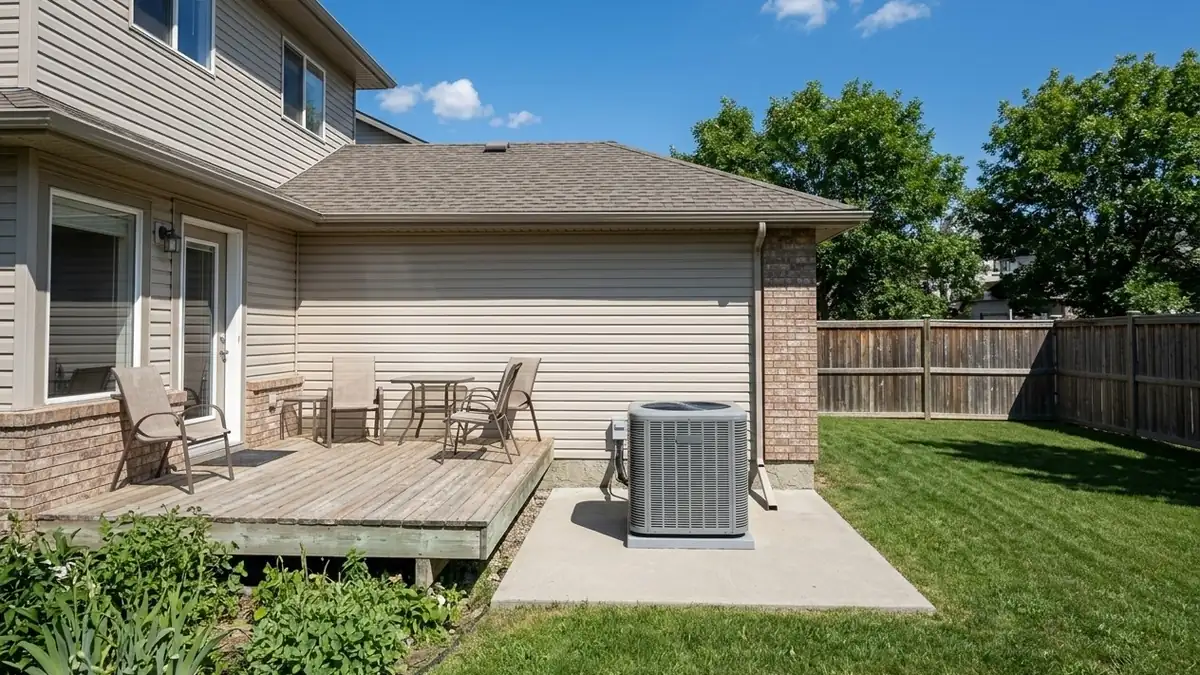
How much does central air cost in Canada?
| Job | Typical range (CAD) | What’s usually included | Basis |
|---|---|---|---|
| Replace an existing central AC, same ductwork | $3,500–$8,500 | New outdoor unit, matching indoor coil, refrigerant lines, connection and start-up | 7 installers and 1 national retailer |
| Large home, or a two-stage or variable-speed system | $10,000+ | Same scope, larger or more efficient equipment | 3 installers |
| Add central air to a home with a furnace and ducts | Not enough published prices | Outdoor unit, a coil added to the furnace, refrigerant lines, a new electrical circuit | — |
| Add central air to a home without ducts | Not enough published prices | New ductwork, a high-velocity small-duct system or ductless units | — |
Sources, checked October 2026: installers Dynamic Heat and Cool, LG Home Comfort and Hawana HVAC (Ontario), Air Force Heating and Action Furnace (Alberta), Provincial Heating and Lynn’s (Manitoba), and Home Depot Canada‘s installation service, which excludes tax. The other sources don’t say whether tax is included.
The ranges are wide because every installation is different, even with the same equipment. The size of the unit, its efficiency, the distance between the outdoor unit and the furnace, the state of your electrical panel and local labour rates all move the price. One Ontario installer notes that labour in the Greater Toronto Area generally costs more than in smaller communities. When you get quotes, ask each installer which of these factors applies to your home.
If you’re adding air conditioning for the first time, expect a quote at or above the replacement range: the installer has to add a coil to your furnace, run new refrigerant lines and usually a new electrical circuit, and none of that is reused from an old system. Homes heated by baseboards or a boiler have no ducts to share, so the quote has to cover new ductwork or a ductless system.
Our page on how we build our price ranges explains how we pick sources and why some rows say “Not enough published prices”.
Central air cost by size and home size
Air conditioners are sized in tons. One ton is 12,000 BTU per hour of cooling, and most homes need between 1.5 and 5 tons. The right size depends on more than floor area: insulation, windows, sun exposure and air leakage all count. The Canadian standard for working it out is CSA F280, a room-by-room heat-gain calculation.
One Hamilton, Ontario installer prices replacements by home size and efficiency:
| Home size | Typical size | Standard efficiency | High efficiency |
|---|---|---|---|
| Up to 1,200 sq ft | 1.5–2 tons | $3,500–$4,500 | $4,500–$5,800 |
| 1,200–1,800 sq ft | 2–2.5 tons | $4,000–$5,200 | $5,200–$6,800 |
| 1,800–2,500 sq ft | 3 tons | $4,500–$5,800 | $5,800–$7,500 |
| 2,500–3,500 sq ft | 3.5–4 tons | $5,200–$6,500 | $6,500–$9,000 |
| 3,500+ sq ft | 4–5 tons | $6,000–$7,500 | $7,500–$10,500+ |
Source: Dynamic Heat and Cool, published March 2026 and updated September 2026. Fully installed; the source doesn’t say whether HST is included. One installer’s prices, so read them as an illustration of how size and efficiency combine.

You’ll see “2-ton” or “3-ton” unit prices online. Those usually cover the outdoor unit alone. The installed price adds the indoor coil, refrigerant lines, electrical work, labour and start-up, and it’s the figure to compare with a quote.
How efficiency changes the price
Since January 1, 2023, a new single-phase split central air conditioner sold in Canada must reach at least SEER2 13.4 (Natural Resources Canada, checked October 2026). SEER2 measures how much cooling a unit delivers for each unit of electricity over a season; higher is better.
Above the minimum, you’re choosing between three kinds of compressor:
- Single-stage units run at full power or not at all. They’re the least expensive.
- Two-stage units have a low setting for mild days, which runs longer, more quietly and removes more humidity.
- Variable-speed units adjust their output continuously. They’re the most efficient and the most expensive.
Across the installers we checked in Ontario and Alberta, moving from a standard unit to a two-stage or high-efficiency one adds roughly $1,000–$3,500 to an installed price, depending on the size of the system.
Your local summer decides whether that premium pays off. Cooling degree-days measure how hard and how long summers push above 18 °C:
| City | Cooling degree-days |
|---|---|
| Windsor | 473 |
| Toronto | 348 |
| Ottawa | 277 |
| Winnipeg | 183 |
| Kelowna | 160 |
| Calgary | 44 |
| Edmonton | 29 |
Source: Environment and Climate Change Canada, Canadian Climate Normals 1991–2020, airport stations.
A Toronto summer calls for about eight times as much cooling as a Calgary one, and a Windsor summer about eleven times. In southern Ontario, a more efficient unit has more hours to earn back its extra cost. In Alberta, where cooling demand is a fraction of that, the savings on your electricity bill are small, and a two-stage unit pays you back in comfort and humidity control rather than on your bill.
Central air conditioner cost by province
| Province | Published installer prices | Electricity rate | Cooling degree-days |
|---|---|---|---|
| Ontario | $3,200–$8,000 for a typical home | 9.8–20.3¢/kWh (time-of-use) | Toronto 348, Ottawa 277 |
| Alberta | Not enough published prices | About 12¢/kWh, energy only | Calgary 44, Edmonton 29 |
| Manitoba | Not enough published prices | 9.97¢/kWh | Winnipeg 183 |
| Saskatchewan | Not enough published prices | 17.02¢/kWh | Regina 124, Saskatoon 105 |
| Nova Scotia | Not enough published prices | 19.13¢/kWh | Halifax 131 |
Electricity rates are the utility’s or regulator’s residential energy charge and exclude delivery, fixed charges and tax. Ontario: Ontario Energy Board, Regulated Price Plan prices in effect since November 1, 2025. Alberta: Utilities Consumer Advocate, Rate of Last Resort for 2026. Manitoba: Manitoba Hydro, from January 1, 2026. Saskatchewan: SaskPower rates, as published by Saskatoon Light & Power, from February 1, 2026. Nova Scotia: Nova Scotia Power, from May 1, 2026. “Not enough published prices” means we found fewer than three independent sources for a provincial range.
The rate matters because it sets what every hour of cooling costs you. The energy charge per kilowatt-hour in Halifax is about twice Winnipeg’s, so the same air conditioner running the same hours costs roughly twice as much in electricity in Nova Scotia, before fixed and delivery charges.
Ontario
Ontario has the most published prices. Three installers (Dynamic Heat and Cool in Hamilton, LG Home Comfort in the Greater Toronto Area and Hawana HVAC) put a typical replacement at $3,200–$8,000. Large homes with high-efficiency systems can pass $10,000. Southern Ontario also has the highest cooling demand in this guide, so a more efficient unit pays off faster here.
If you’re on the Regulated Price Plan’s time-of-use prices, the hours when air conditioning runs hardest, summer weekday afternoons, fall in the higher-priced periods.
Several companies in Ontario rent air conditioners and furnaces on monthly contracts. Before you sign one, ask:
- What is the monthly rate, and how much can it rise each year?
- How long is the contract, and what does it cost to buy out or cancel?
- What happens to the equipment, and the contract, if you sell your home?
Then compare the total payments over the contract with the price of buying the same unit outright.
Alberta
Two Alberta installers publish prices, one short of the three we need for a provincial range. One Calgary installer lists $4,500–$8,500 fully installed, with an average single-zone job of $5,800–$6,800, including the indoor coil, refrigerant lines, electrical work, the City of Calgary permit and start-up (Air Force Heating, May 2026). Another installer serving Calgary, Edmonton and Red Deer lists central air from about $6,500 (Action Furnace, May 2026).
Alberta also has the lowest cooling demand in this guide: 44 cooling degree-days in Calgary and 29 in Edmonton. A high-efficiency unit saves little on electricity here, so a standard model is usually the better value unless comfort or humidity control is a priority. Alberta’s default electricity rate covers energy only; delivery charges are billed separately.
Manitoba and Saskatchewan
In Winnipeg, one installer puts central air at $3,500–$7,500 installed, or $4,500–$6,000 for a 1,200–2,000 sq ft home (Provincial Heating, June 2026), and another at $4,500–$5,500 (Lynn’s, September 2025).
We didn’t find any Saskatchewan installer that publishes central air prices. Manitoba has the cheapest electricity in this guide, which keeps running costs low; Saskatchewan’s rate is about 70% higher.
British Columbia and Atlantic Canada
We didn’t find enough published central air prices in British Columbia or Atlantic Canada for a range. Cooling demand is low on the coasts (61 cooling degree-days in Vancouver, 131 in Halifax) and higher in the BC Interior (160 in Kelowna), where central air is more likely to pay its way.
What a central air quote should include

A complete quote lists:
- The outdoor unit (condenser), with brand, model number and size.
- The indoor coil, matched to the outdoor unit and compatible with your furnace.
- New refrigerant lines, or a check that the existing ones can be reused.
- A pad or wall bracket for the outdoor unit.
- Electrical work: the disconnect, the circuit, and whether your panel has room for it. One Ontario installer’s basic price assumes your home already has a dedicated circuit for the air conditioner, so ask whether a new one is included.
- Any permits and inspections, and who arranges them.
- Refrigerant charge, start-up and testing.
- Removal and disposal of the old unit and its refrigerant. Home Depot Canada’s installation service includes removal but warns that a disposal fee may apply, so ask whether it’s in the total.
- The thermostat, if it’s being replaced.
- Parts and labour warranties, and who registers the manufacturer’s warranty.
Common extras that push a quote up include an electrical panel upgrade, long refrigerant line runs and a second cooling zone. Panel upgrades alone run $800–$2,500 at one Calgary installer and $1,500–$3,000 or more at one in Winnipeg, so if your panel is older or full, ask for that line separately.
If a quote lands well above or below the ranges on this page, ask what’s driving it. A high quote may include a panel upgrade or larger equipment; a low one may leave out the coil, the permit or removal of the old unit.
Replace the air conditioner alone, or with your furnace?
When an older air conditioner fails, ask your installer whether to replace the furnace at the same time. Doing both together makes sense when:
- The furnace is close to the end of its life, so you’d be replacing it within a few years anyway.
- The new air conditioner’s coil needs to match the furnace’s blower, and the old furnace isn’t a good match.
- You want one installation visit and warranties that start on the same day.
If the furnace is relatively new and working well, replacing only the air conditioner is usually the simpler choice. Ask the installer to confirm the new coil is compatible with your furnace.
For furnace prices on their own, see our guide to new furnace cost in Canada.
Central air or a heat pump?
A ducted air-source heat pump uses the same outdoor unit, coil and ductwork as central air, but it can run in reverse to heat your home too. In summer it cools like an air conditioner. In winter it can carry much of the heating load, with your furnace taking over in the coldest weather.
Whenever your air conditioner needs replacing, ask for a heat pump quote alongside it, especially if your electricity is cheap compared with gas, as it is in Manitoba. Expect a heat pump to cost more to install than central air. To judge the savings, ask each installer to estimate running costs from your own gas and electricity bills, and check how much heat the model delivers in cold weather.
Heat pump rebates from governments and utilities change often. Check current programs before you decide, and don’t count a rebate in your budget until you’ve confirmed you qualify.
How to compare central air quotes
- Get at least three quotes. Prices for the same home can differ widely, as the ranges on this page show.
- Ask how the size was worked out. A CSA F280 heat-gain calculation is the standard. If an installer only matches the size of your old unit, ask why: new windows, insulation or an addition since it was installed can all change the size you need.
- Ask for the matched system’s certified rating. The outdoor unit and indoor coil are rated together. Ask for the AHRI certificate number of the combination you’re being quoted, which confirms its SEER2.
- Compare scope before totals. Line up what each quote includes using the checklist above.
- Compare labour warranties. Manufacturers cover parts; labour coverage comes from the installer, and it varies widely. Home Depot Canada’s installation service lists 1 year of labour, while one Alberta installer advertises 12 years of parts and labour on select cooling installs.
- Ask about timing. If your current unit still works, ask whether booking outside the summer rush changes the price or the wait.
Frequently asked questions
How much does central air cost for a 2,000 sq ft home in Canada?
For a home of about 2,000 sq ft with existing ductwork, installers publish replacement prices of roughly $4,500–$9,500 CAD, depending on efficiency: $4,500–$7,500 at one Hamilton installer (1,800–2,500 sq ft), $4,500–$8,000 and $5,500–$9,500 at one in the Greater Toronto Area (1,500–2,000 and 2,000–2,500 sq ft), and $5,800–$8,800 at one in Calgary. Ask for a CSA F280 calculation before you settle on a size.
Is central air cheaper than a ductless mini split?
For one room, no: a single-zone ductless mini split costs about $2,500–$6,000 installed, according to installers in Hamilton, Winnipeg and Calgary. To cool a whole house, you need one indoor unit per zone, and each adds to the price. One Hamilton installer lists $6,500–$10,000 for three zones and $9,000–$13,500 or more for four. If your home already has ducts, ask for both quotes: central air often comes in lower.